The Outcome Era: Why Agents Are Replacing Tools
The Outcome Era: Why Agents Are Replacing Tools
TL;DR
AI agents are replacing traditional tools by delivering finished outcomes instead of drafts. Instead of learning software interfaces, users describe what they want and receive production-ready results. This shift from tool-first to outcome-first work is transforming how teams build presentations, websites, marketing campaigns, and products in 2026.
For years, the software landscape followed a familiar model: buy a tool, learn its interface, and build something manually. Whether it was Google Slides, Canva, or WordPress, the workflow looked the same. You started with a blank canvas and assembled the final output step by step.
In 2026, that model is breaking.
AI agents are replacing the tool-first approach with something fundamentally different: outcome-first work . Instead of learning tools, you describe what you want. Instead of starting from scratch, you receive finished outputs. This shift represents one of the most significant changes in how work gets done in years.
How Agents Compress Multiple Tools Into One
Traditional SaaS stacks forced specialization. Canva for graphics. Gamma for slides. Website builders for landing pages. Video editors for content. Each tool added cost , learning time , and workflow friction.
Agents collapse this fragmentation.
One agent-driven platform now handles presentations, websites, images, videos, documents, and carousels from a single interface. You no longer choose tools based on format. You choose an agent that delivers outcomes across formats.
A marketing launch illustrates this well. Traditionally, designers, developers, copywriters, and video editors work across multiple tools. With an agent, you describe the campaign and receive landing pages, visuals, emails, and videos that are brand-consistent and ready to deploy.
Runable exemplifies this compression. Starting at $9/month, it replaces Canva, Gamma, website builders, video editors, image generators, and document tools with a single agent-driven platform. Instead of managing multiple subscriptions, users manage one system that plans, designs, and produces finished artifacts.
What an Outcome-First Agent Like Runable Actually Does
An outcome-first agent is defined by how far it carries execution .
Runable operates as a general AI agent that delivers work end to end across formats, without tool switching or context resets.
AI Websites
Runable generates production-ready websites from a single description. The agent plans structure, writes copy, designs layouts, sets up backend logic, integrates payments and authentication, and deploys with custom domains. You start with a working product, not a blank page, and refine visually, via chat, or in code.
AI Slides
Runable creates presentation-ready decks for pitches, sales, and internal use. It handles research, narrative flow, design, and visuals. Slides can be edited section by section and exported to PDF, PPTX, or Google Slides without regenerating the entire deck.
AI Documents & Reports
Runable produces structured proposals, reports, briefs, and guides by conducting research, organizing content, formatting professionally, and adding citations. The entire research-to-document flow happens in one pass.
Brand Campaigns
From a single campaign goal, Runable generates landing pages, ad creatives, social carousels, emails, and supporting visuals brand-consistent and ready to deploy. Iteration stays inside the same workspace.
AI Images & Video
Runable generates and edits images and videos as part of the same workflow. Visuals can be styled, extended, upscaled, remixed, and refined on a timeline, treated as components of an outcome rather than standalone assets.
Across all formats, the workflow stays the same: describe the outcome, review what the agent produces, refine where needed, and ship. No exporting. No rebuilding.
Real-World Applications Across Industries
Marketing teams generate ads, landing pages, and social content simultaneously.
Sales teams create customized pitch decks in minutes.
Creators repurpose content across formats effortlessly.
Developers generate full-stack MVPs and skip repetitive setup.
Small businesses handle work they previously outsourced.
Across industries, agents reduce execution time while improving output quality.
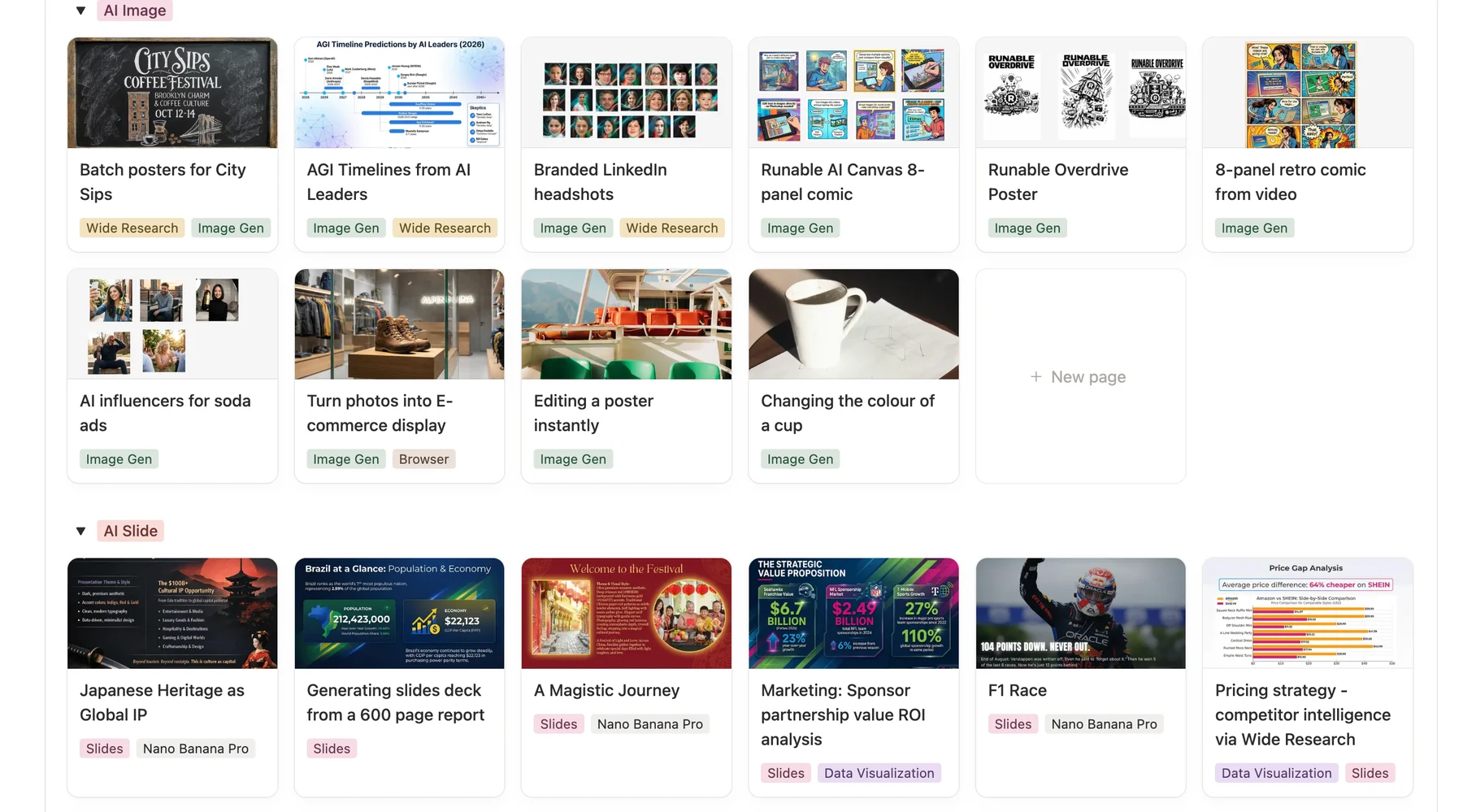
Check more usecases from here
The Economics of Agents vs Tools
Traditional subscriptions add up quickly. Multiple tools mean higher costs and slower workflows.
Agents consolidate spend. Runable’s $32/month Max plan replaces more than ten subscriptions while delivering finished outputs faster. Credits apply only to generation. Editing and exporting remain free, aligning cost with actual value creation.
For teams and agencies, the economics improve further as per-user costs drop and throughput increases.
Preparing for an Outcome-Driven Future
The shift to agents isn’t theoretical, it’s happening now.
Individuals spend less time learning software and more time refining ideas.
Teams focus on strategy instead of mechanics.
Organizations hire for judgment and clarity, not tool expertise.
The outcome era reallocates skilled work from execution overhead to higher-value thinking.
Key Takeaway
2026 marks a real inflection point.
The tool-first era, where productivity depended on mastering interfaces, is giving way to an outcome-first era where clarity of intent matters more than technical skill.
Agents are replacing tools because they deliver finished outcomes instead of blank canvases. They compress workflows, reduce costs, and handle complexity automatically.
The advantage now belongs to those who stop asking which tool to use and start asking what outcome they want .