GPT-6.2 Astra vs Sol: Which OpenAI Model Should You Pay For?
Key Takeaways
- GPT-6.2 Sol is the better default for most business workflows. Astra costs four times more per token at standard API rates, but its stronger performance can justify the premium for demanding professional work where output quality matters more than cost or speed.
- Same launch, same context window: OpenAI released both GPT-6.2 Astra and GPT-6.2 Sol on November 17, 2026, and both models support a 1.05M-token context window (up to 128K output tokens).
- API pricing (as of November 2026): Standard API rates are $8 input, $0.40 cached input, and $40 output per million tokens for GPT-6.2 Astra, versus $2 input, $0.10 cached input, and $10 output for GPT-6.2 Sol. Ultrafast mode is available for both on the API. Ultrafast currently costs 3× Standard through February 28, 2027, after which OpenAI says it will cost 6× Standard. (OpenAI API pricing)
- ChatGPT access: Both models are available in ChatGPT Work and Codex on Plus, Pro (including Pro 200 and Pro 500), Enterprise, and Edu plans, with usage depending on plan allowances and task size (OpenAI). Regular ChatGPT Chat keeps its existing model choices.
- You do not have to lock into one model: Teams can start on a lower-cost everyday model and switch to a flagship model per task when higher stakes or complexity justify the spend.
GPT-6.2 Astra vs Sol at a glance
| GPT-6.2 Astra | GPT-6.2 Sol | |
|---|---|---|
| Best for | Demanding professional work, complex coding, long-horizon agents | Everyday business workflows at lower cost |
| Release date | November 17, 2026 | November 17, 2026 |
| API price (Nov 2026, standard) | $8/M input, $0.40/M cached, $40/M output | $2/M input, $0.10/M cached, $10/M output |
| Context window | 1.05M tokens (up to 128K output) | 1.05M tokens (up to 128K output) |
| Artificial Analysis Intelligence Index v5.0.1 (max effort) | 62.1 | 57.3 |
| AA-3D (interactive web/3D design) | 1,318 Elo | 1,259 Elo |
| ChatGPT availability | ChatGPT Work & Codex (Plus, Pro, Enterprise, Edu) | ChatGPT Work & Codex (Plus, Pro, Enterprise, Edu) |
What is GPT-6.2 Astra?
GPT-6.2 Astra is OpenAI's frontier model for complex, high-stakes projects, released on November 17, 2026 alongside GPT-6.2 Sol. It carries a 1.05M-token context window and is positioned for demanding professional deliverables (slides, spreadsheets, financial models, legal documents), complex software engineering, computer use, and multi-step agentic workflows.
OpenAI's launch benchmarks highlight where Astra separates itself from both earlier models and competing frontier models:
- Agents' Last Exam (long-horizon professional workflows): GPT-6.2 Astra sets a new high, scoring 5.2 points higher than GPT-6 Astra at less than a third of the cost, and 5.5 points ahead of Claude Fable 5.2 at 5% of the cost.
- GDPval v2 (real-world consulting, finance, and marketing projects): Leads the models OpenAI tested, up 6.2 percentage points over GPT-6 Astra while using 22% fewer output tokens.
- AA-AnalystAgent (spreadsheet and financial-report analysis): Sets a new high, answering 62.5% of questions correctly across all five independent attempts.
- Harvey LAB-AA v1.1 (legal work): More than doubles Claude Fable 5.2's pass rate at about one-sixth the cost.
- Artificial Analysis Intelligence Index v5.0.1 & AA-3D: Scores 62.1 on the Intelligence Index at max effort and ranks first on AA-3D at 1,318 Elo, ahead of Claude Fable 5.2 at 1,271.
The trade-off is price. Standard API rates are $8 per million input tokens, $0.40 for cached input, and $40 per million output tokens (a 20% input/output cut and 60% cached-input cut compared with GPT-6 Astra, but still 4x the per-token price of GPT-6.2 Sol).
What is GPT-6.2 Sol?
GPT-6.2 Sol is OpenAI's efficient, versatile model for everyday work, launched on the same day (November 17, 2026) with the same 1.05M-token context window. Rather than sacrificing context length, Sol keeps the full window while cutting standard API token prices to one-fourth of Astra's rates ($2/M input, $0.10/M cached input, and $10/M output, matching GPT-6.1 Sol's pricing).
OpenAI positions Sol as its go-to default for both technical and non-technical workflows, and the published benchmarks show how close it gets to flagship quality on many tasks:
- Cognition FrontierCode 2.0: Comes within 0.5 points of GPT-6.2 Astra at roughly one-fifth the cost.
- Artificial Analysis Intelligence Index v5.0.1: Scores 57.3 at max effort, about five points behind Astra's 62.1.
- GDPval v2: Improves 5.3 points over GPT-6.1 Sol on knowledge-work assignments.
- LifeVal (challenging everyday tasks): Outscores GPT-6 Astra at about one-seventh the cost.
- AA-3D: Scores 1,259 Elo compared with Astra's 1,318 Elo.
For routine business writing, summarizing, data extraction, classification, and standard coding or workflow steps, Sol delivers strong quality while keeping token budgets and plan allowances stretching much further.
What does each model actually cost a business?
On the API, Astra costs exactly 4x as much per token as Sol across standard input, cached input, and output rates. In practice, total task cost depends on both token rate and how many output tokens a model uses to finish the job.
Here is the official pricing and access picture as of November 2026:
- Standard API (pay per use): GPT-6.2 Astra is $8/M input, $0.40/M cached input, and $40/M output. GPT-6.2 Sol is $2/M input, $0.10/M cached input, and $10/M output. (OpenAI API pricing)
- Ultrafast API tier: Available for both GPT-6.2 Astra and GPT-6.2 Sol. Ultrafast currently costs 3× Standard through February 28, 2027, after which OpenAI says it will cost 6× Standard. (OpenAI API pricing)
- Prompt caching matters: Cached input drops rates by 95% on both models ($0.40/M on Astra, $0.10/M on Sol). OpenAI recommends keeping prompt prefixes unchanged and appending new instructions to maximize cache reuse.
- ChatGPT Work and Codex access: Both GPT-6.2 Astra and GPT-6.2 Sol are available in ChatGPT Work and Codex on Plus, Pro (Pro 200 and Pro 500), Enterprise, and Edu plans (OpenAI). Usage limits depend on your plan allowance, task size, and model choice rather than a flat daily message count. Pro 500 includes Ultrafast for both models, and Pro 200 adds Ultrafast starting with GPT-6.2 Sol (with admin-enabled equivalents on eligible Enterprise and Edu workspaces). Regular ChatGPT Chat keeps its existing model picker.
To put the 4x API gap into concrete annual math, take an explicit example: a team running 50 API tasks per operating day across 260 business days per year (13,000 tasks/year), assuming an average of 10,000 uncached input tokens and 2,500 output tokens per task.
- GPT-6.2 Sol formula: ((10,000 x $2) + (2,500 x $10)) / 1,000,000 = $0.045 per task x 13,000 tasks = $585/year .
- GPT-6.2 Astra formula (at the same token count): ((10,000 x $8) + (2,500 x $40)) / 1,000,000 = $0.18 per task x 13,000 tasks = $2,340/year .
If a complex Astra task also generates more output tokens than Sol, the annual spread widens further; conversely, heavy prompt caching can shrink both totals substantially.
What Earlier Astra and Sol Models Look Like on Runable
GPT-6.2 was not yet available on Runable when we conducted this comparison, so we tested its predecessors: GPT-6 Astra and GPT-6.1 Sol, which are available alongside GPT-6 Sol in Runable's model directory. These results should not be treated as GPT-6.2 benchmarks, but they demonstrate the practical trade-off businesses face between a frontier model and a faster, lower-cost everyday model.
We gave both models the same presentation, spreadsheet-analysis and landing-page tasks. We then compared Runable credit usage, corrections required and final-output quality.
| Runable test | GPT-6 Astra | GPT-6.1 Sol | Better choice |
|---|---|---|---|
| Presentation quality | 6 slides; native margin chart, styled budget table, and timeline | 6 slides; cleaner but simpler numbered-list layouts | GPT-6 Astra (visual polish) |
| Spreadsheet accuracy | Caught the duplicate row and the loss-making channel; same clean totals | Caught the duplicate row and the loss-making channel; same clean totals | GPT-6.1 Sol (same result, 4.6x fewer credits) |
| Landing-page completion | Brief met on first pass (working 15% annual toggle, 4-question FAQ) | Brief met on first pass (working 15% annual toggle, 4-question FAQ) | GPT-6.1 Sol (same completion, 6.2x fewer credits) |
| Credits consumed | 1,984 total (641 deck, 166 sheet, 1,177 site) | 309 total (83 deck, 36 sheet, 190 site) | GPT-6.1 Sol (6.4x fewer credits) |
| Corrections required | 0 follow-up rounds | 0 follow-up rounds | Tie |
Test setup (November 23, 2026): identical briefs run once per model on Runable cloud workspaces: a 6-slide board expansion deck, a 13-row Q3 channel CSV containing an embedded duplicate row and margin anomaly, and a single-page bookkeeping website with a 15% annual pricing toggle and FAQ accordion.
What the outputs looked like
Same prompt, same day, one run each. Here is what each model handed back.
GPT-6 Astra vs GPT-6.1 Sol, finished outputs side by side (30 seconds): 0:00 board deck, 0:09 Q3 spreadsheet analysis, 0:15 landing page, 0:24 credits used. Fictional companies, Runable test, November 23, 2026. Not GPT-6.2.
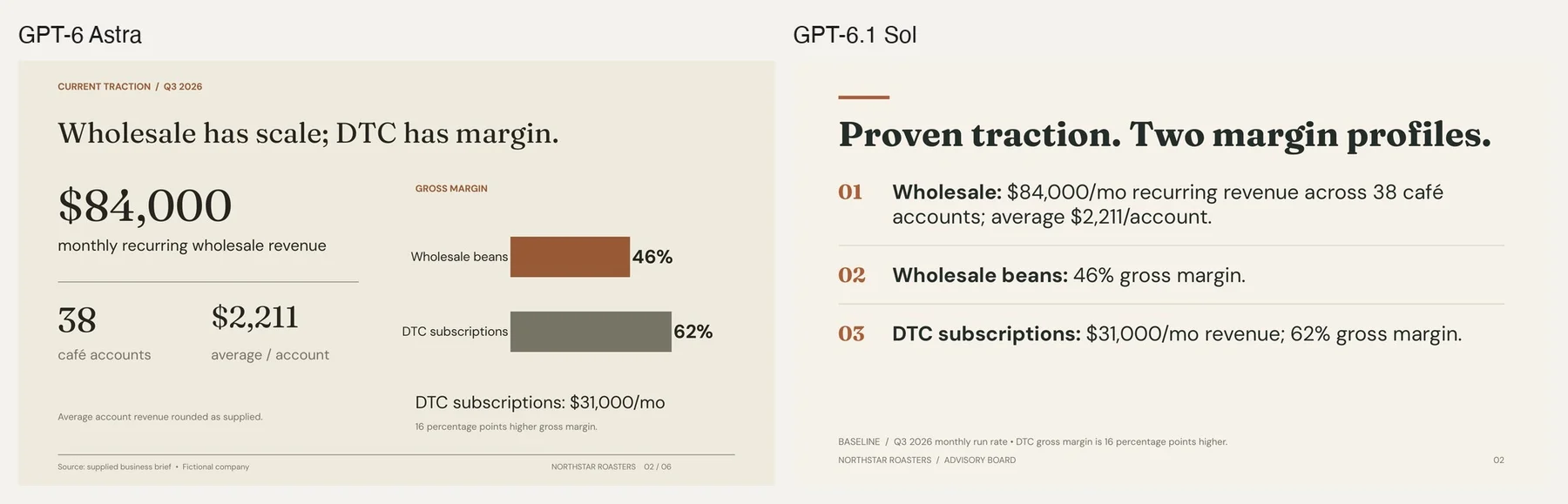
Test 1: A 6-slide board deck (GPT-6 Astra: 641 credits. GPT-6.1 Sol: 83 credits.)
Prompt (abridged): build a polished 6-slide deck for a fictional coffee roaster, Northstar Roasters, pitching a Q1 2027 wholesale expansion. Use the exact figures supplied ($84,000/mo across 38 café accounts, 46% vs 62% gross margin, a $42,000 budget request) and keep the copy tight.
Both decks kept every supplied number intact. Astra built a native margin chart and a styled budget table. Sol used large numbered lists with the same figures.
Test 2: A messy Q3 sales spreadsheet (GPT-6 Astra: 166 credits. GPT-6.1 Sol: 36 credits.)
Prompt (abridged): analyze a 13-row Q3 channel CSV for a fictional retailer, Harbor Home Goods. Check the totals and data quality first, then write an executive summary under 400 words with a table, name the channel losing money, and give 3 Q4 budget recommendations using exact numbers.
The CSV had one trap, a September Paid Social row listed twice. Both models caught it and reported the same clean Q3 numbers:
| Cleaned Q3 result | Both models |
|---|---|
| Net revenue | 324,018 |
| Contribution profit | 121,648 (37.54% margin) |
| Top profit channel | Organic Search, 66,946 |
| Only loss-making channel | Paid Social, −1,400 |
| Raw totals with the duplicate | 350,898 net revenue, 118,688 profit |
They differed on the Q4 advice, and that is where the judgment shows:
| Q4 recommendation | GPT-6 Astra | GPT-6.1 Sol |
|---|---|---|
| Paid Social | Cut by 10,000 (39,400 to 29,400) | Cut 90% (39,400 to 3,940) |
| Paid Search | Raise by 8,000 (22,950 to 30,950) | Raise by 12,000 (22,950 to 34,950) |
| Raise by 2,000 (1,200 to 3,200) | Raise by 2,400 (1,200 to 3,600) | |
| Total budget | Held flat at 63,550 | 21,060 held in reserve |
Neither answer is wrong. Astra's is a gradual shift that keeps the total budget unchanged. Sol's is a bolder cut with money held back. Both label these as tests, not forecasts. Which one you prefer is a business call, and this is the kind of choice a person should still make.
Test 3: A single-page website (GPT-6 Astra: 1,177 credits. GPT-6.1 Sol: 190 credits.)
Prompt (abridged): build a single-page site for a fictional bookkeeping service, LedgerLeaf, with a hero, a 3-step "how it works", three pricing tiers ($149, $299 and $549 a month) with a working Monthly/Annual (save 15%) toggle, a 4-question FAQ accordion, and a footer with hello@ledgerleaf.co. Style: off-white, deep forest green, editorial.
Both pages met the brief and used the same pricing. Astra went for a dark green hero panel, Sol for a lighter sage one.
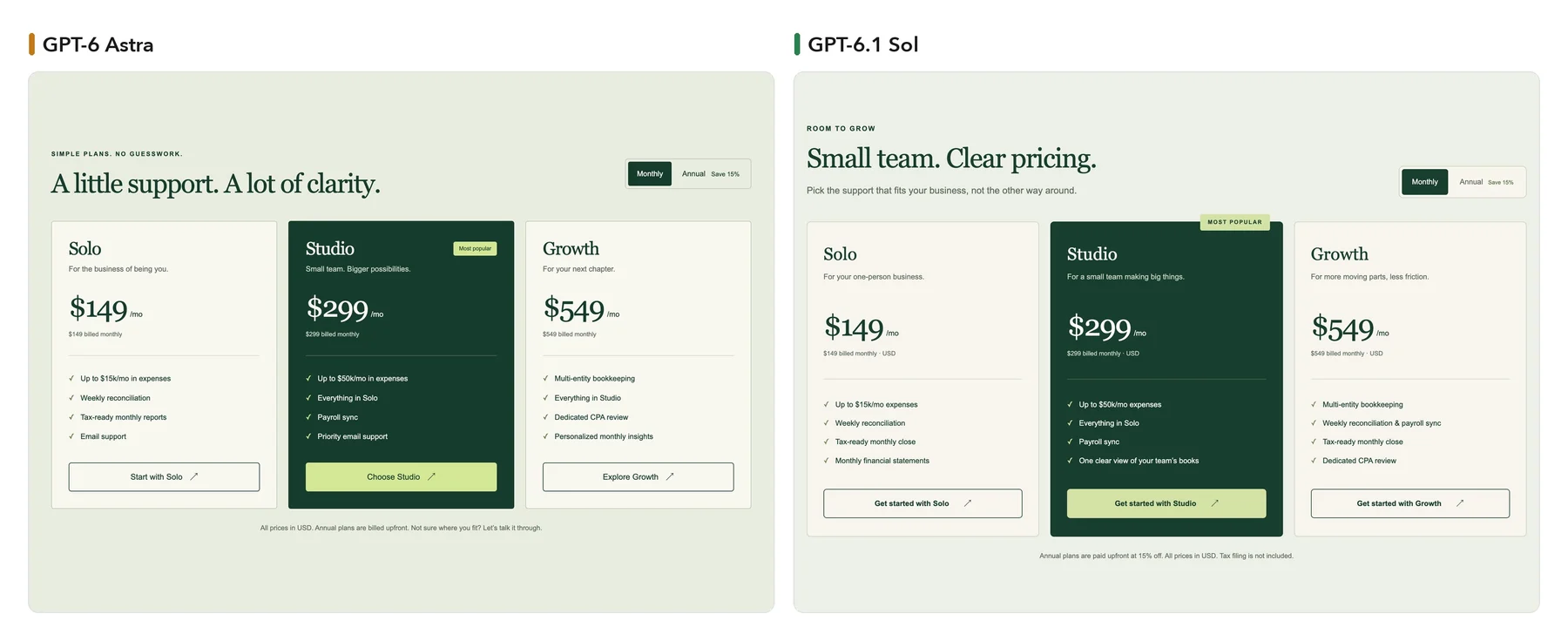
In this three-task spot check, Astra’s clearest advantage was presentation polish. Both models completed the spreadsheet and landing-page tasks correctly without follow-up corrections, while Sol used 6.4× fewer credits overall. Because each task was run only once, treat these results as a practical example rather than a controlled benchmark.
When is GPT-6.2 Astra worth paying for?
Astra is worth paying for when the cost of a subtle error or a weak deliverable outweighs a 4x token premium. Based on OpenAI's launch evaluations and the categories Astra was trained for, it earns its price in four situations:
- Multi-step work with compounding errors: Workflows with many dependent steps where a mistake early in the chain ruins the final output.
- High-stakes financial, legal, and analytical deliverables: Valuation workbooks, multi-sheet reconciliations, investment memos, and contract reviews where missing one clause or figure creates real liability.
- Template-faithful slides and polished visual builds: Client-ready decks, interactive web frontends, and complex 3D or CAD-adjacent work where fewer revision rounds save hours of team time.
- Complex coding and tool-using agents: Multi-service debugging, production code changes, and long-horizon agent runs where stronger planning reduces dead ends. If you are evaluating best AI agents for small business, frontier-tier models still anchor the hardest autonomous workflows.
If a task is low-stakes or easy for a human to verify in 30 seconds, paying 4x per token for Astra rarely pays back.
When is GPT-6.2 Sol enough?
Sol is enough for the high-volume, clearly scoped tasks that make up the bulk of a small business's daily AI usage. Because Sol shares Astra's 1.05M-token context window, you no longer have to upgrade to the flagship model just to pass in long documents or large codebases.
Sol is a strong default for:
- Customer email drafts, support ticket triage, and meeting summaries.
- Blog outlines, product descriptions, marketing copy, and localization.
- Structured extraction from clean invoices, receipts, and forms.
- Everyday coding edits and well-scoped automation steps (remembering Sol came within 0.5 points of Astra on FrontierCode 2.0 at about one-fifth the cost).
The main risk with defaulting to Sol is letting a task quietly cross into complex financial math, legal interpretation, or ambiguous multi-step judgment without noticing. A simple team rule works well: default to Sol, and escalate anything involving money math, legal commitments, or unverified multi-step autonomy to Astra or a human review pass.
Neither model should replace qualified human review for legal, financial, tax or other high-stakes decisions.
Do you have to choose between Astra and Sol?
No. Most teams get the best economics by treating model choice as a per-task decision rather than a single company-wide subscription.
On the OpenAI API, you can call gpt-6.2-sol by default and send only high-stakes or complex jobs to gpt-6.2-astra. Inside ChatGPT Work and Codex, users on eligible plans can switch between the two models in the model picker depending on the job in front of them.
For teams that want models and execution tools in one workspace, Runable (our product, disclosed upfront) lets you pick from multiple leading models, including GPT-6 Astra, GPT-6.1 Sol and Claude models listed in Runable's model directory, right next to slides, spreadsheets, documents, web builds, and connected apps. Plans start on a Free tier, with Pro at $20/mo and Max at $100/mo (as of November 2026). The honest trade-off: if you specifically need GPT-6.2 inside ChatGPT Work or Codex today, use OpenAI directly until GPT-6.2 rolls into your other tools; if you want one workspace to compare models side by side on actual deliverables, Runable keeps everything in one place.
How to choose between GPT-6.2 Astra and Sol
Choose by task profile, not by headline benchmarks. Look at how much of your week is repeatable everyday execution versus high-stakes judgment, and pay the 4x premium only where quality moves the outcome.
A quick decision path:
- Mostly drafting, summarizing, extracting, and standard coding? Start with GPT-6.2 Sol via ChatGPT Work, Codex, or the API. It gives you the same 1.05M context window at one-fourth the API token price.
- Daily financial modeling, legal drafting, complex architecture, or long agent runs? Budget for GPT-6.2 Astra on those specific workflows and seats, where fewer revision cycles and lower error rates justify the higher rate.
- Automating recurring workflows across your business? Match each step in your small-business AI automation to the model it actually needs (Sol for routine steps, Astra only for the critical reasoning steps), and keep prompt prefixes stable to capture the 95% cached-input discount.
- Not sure where your own work sits? Run three to five of your real recurring briefs through both models once, compare accuracy and revision effort side by side, and standardize from actual outputs.
Related Reading
- Best AI Agents for Small Business in 2026 (By Category)
- AI Automation for Small Business: What to Automate First
- AI Tools for Small Business: 10 Best in 2026 (Tested)
- Best AI Agents 2026: 7 Tools Tested, Ranked & Priced
- AI Workflow Automation: 7 No-Code Workflows for 2026
- What Is an AI Agent? A Plain-English Guide for 2026
FAQ
Is GPT-6.2 Astra better than Sol for small business?
GPT-6.2 Astra is stronger on complex, high-stakes professional work such as financial modeling, legal document analysis, complex coding, and long-horizon agent workflows. For the everyday drafting, summarizing, extraction, and routine work that fills most small-business days, GPT-6.2 Sol offers the same 1.05M-token context window at one-fourth the standard API token price, making Sol the better default for most teams.
How much does GPT-6.2 Astra cost compared to Sol?
As of November 2026, standard OpenAI API pricing for GPT-6.2 Astra is $8 per million input tokens ($0.40 cached) and $40 per million output tokens. GPT-6.2 Sol costs $2 per million input tokens ($0.10 cached) and $10 per million output tokens, making Astra 4x more expensive per token (OpenAI API pricing). Both models also offer an Ultrafast API tier. Ultrafast currently costs 3× Standard through February 28, 2027, after which OpenAI says it will cost 6× Standard.
Do GPT-6.2 Astra and Sol have different context windows?
No. Both GPT-6.2 Astra and GPT-6.2 Sol support a 1.05M-token context window with up to 128K output tokens (Astra, Sol), so you do not need to pay for Astra solely to work with long documents or large repositories.
Where can I access GPT-6.2 Astra and Sol in ChatGPT?
Both models are available in ChatGPT Work and Codex across Plus, Pro (including Pro 200 and Pro 500), Enterprise, and Edu plans (OpenAI), subject to plan allowances and task size. Regular ChatGPT Chat keeps its existing model choices.
What tasks should go to Astra instead of Sol?
Send Astra your highest-stakes and most complex work: multi-sheet financial reconciliation, contract and legal analysis, complex multi-file software changes, template-exact executive decks, and long multi-step agent runs where an early error would derail the final deliverable.
The bottom line
The smartest way to decide between a flagship model and an everyday model is to test them on your actual briefs instead of guessing from leaderboards. Run three to five of your real tasks through both, compare the finished output against the cost, and pay for Astra only where the difference shows up in the result.