Gemini 4 Neon Pricing: What $3/$15 Means for Your Business
Key Takeaways
- Gemini 4 Neon costs $3 per million input tokens and $15 per million output tokens , with a 1 million-token context window. Google positions it for complex coding, analytical reasoning and production-grade enterprise workflows, not as a cheap everyday model. Prices below are as of Nov 21, 2026, three days after launch.
- The $3/$15 figure is API pricing , not a Workspace seat price. It does not directly change your Workspace subscription. Whether you can use Neon in Google's own products depends on your plan, the product and your administrator's settings.
- Neon is not on the API free tier . Cached input is $0.15 per million tokens, and Batch and Flex are half price ($1.50/$7.50). Thinking tokens bill as output, so a task that "thinks" costs more than the visible answer suggests.
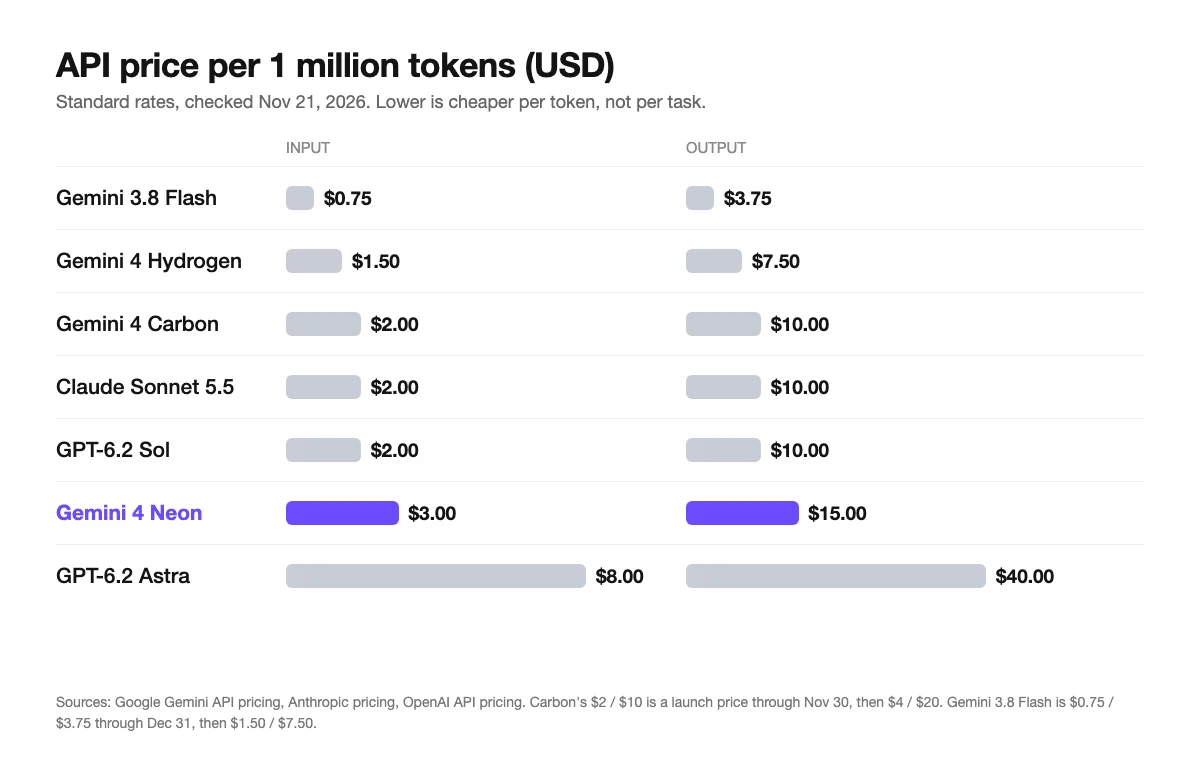
- Per token, Neon is dearer than Claude Sonnet 5.5 and OpenAI's GPT-6.2 Sol (both $2/$10) and cheaper than GPT-6.2 Astra ($8/$40). Google says Neon costs about 32% less per task than Gemini 4 Carbon at its default setting, and 50% to 80% less per task than some competing frontier models. Those are Google's figures, so treat them as a claim to test on your own work.
- For most small-business tasks, our opinion is that a cheaper model is the better starting point. Use Neon where a wrong answer is expensive or the input is very long.
- Businesses that do not want to manage API keys or per-token billing can use an agent platform such as Runable, which works through plans and credits. Runable is our product, and we have not tested Neon inside it.
Gemini 4 Neon at a glance: how the pricing stacks up
| Model | Input $/M tokens | Output $/M tokens | Notes |
|---|---|---|---|
| Gemini 4 Neon | $3.00 | $15.00 | 1M context. Paid only. Cached input $0.15. Batch and Flex $1.50/$7.50 |
| Gemini 4 Hydrogen | $1.50 | $7.50 | Cached input $0.075 |
| Gemini 4 Carbon | $2.00 | $10.00 | Launch price through Nov 30, 2026, then $4/$20 |
| Gemini 3.8 Flash | $0.75 | $3.75 | Through Dec 31, 2026, then $1.50/$7.50. Has a free tier |
| Claude Sonnet 5.5 | $2.00 | $10.00 | 1M context |
| OpenAI GPT-6.2 Sol | $2.00 | $10.00 | Standard rate |
| OpenAI GPT-6.2 Astra | $8.00 | $40.00 | Standard rate |
Prices are published per-million-token API rates checked on Nov 21, 2026, from Google's Gemini API pricing page, Anthropic's Sonnet page and OpenAI's API pricing page. Providers change these often, so check them before committing to volume.
What is Gemini 4 Neon, and what does $3/$15 actually mean?
Gemini 4 Neon is a model in Google's Gemini 4 family, announced on Nov 18, 2026. Google describes it as bringing frontier-level intelligence to complex software engineering, knowledge work and science, and its launch post pitches it at enterprise, analytical and scientific work. Hydrogen, one tier down, is the model Google pitches for everyday coding and agentic workflows.
The $3/$15 shorthand refers to the two per-million-token rates. Input tokens are everything you send the model: your prompt, the document you paste in, the spreadsheet it reads. Output tokens are everything it writes back. Output costs more because generating text takes more compute than reading it.
As a rule of thumb, a token is about three-quarters of an English word, so a million tokens is roughly 750,000 words. Most small-business tasks are tiny against that. A customer email with 400 tokens in and 250 tokens out costs about $0.005, which is half a cent.
One detail matters more than the sticker price. Google's pricing page says the $15 output rate includes thinking tokens, and that every token the model processes is counted and billed, including thinking tokens and internal tool system instructions and function declarations when using grounding. So the bill covers more than the visible answer. Neon "thinks" before it answers, and you pay for that thinking even though you never see it.
How does Gemini 4 Neon compare to Claude, GPT and other Gemini models?
On sticker price, Neon sits above the mid-tier models and below the most expensive one. It costs 50% more than Claude Sonnet 5.5 and GPT-6.2 Sol on both input and output, and about 60% less than GPT-6.2 Astra.
Context window. Neon has a 1 million-token context window. So does Claude Sonnet 5.5, so a long context alone no longer sets Neon apart. It does mean a long contract or a full inbox can go in one pass, which avoids chunking.
Cost per task, not per token. Google says that at its default high thinking level Neon costs 32% less per task than Gemini 4 Carbon, and roughly 50% to 80% less per task than top competing frontier models. That is Google's own claim from its launch post. Independent testing is more mixed. Artificial Analysis scored Neon 61 on its Intelligence Index at xhigh thinking, but called it "somewhat expensive" next to models of similar price and noted it was slow and verbose. Its cost figure was $6.44 per task on its own benchmark, which is not a typical small-business task.
Where it ranks. At launch, Google cited Neon as #3 on the Artificial Analysis Intelligence Index at xhigh. Its live ranking has since moved (the Artificial Analysis page showed #6 of 95 on Nov 21, 2026), although its score remains 61. Google also reported #2 on the Vals Index at 70.9%. Benchmarks measure benchmark tasks, so a test on your own documents tells you more.
The honest counterpoint is that for short prompts with short answers (subject lines, chat replies, classification), Gemini 3.8 Flash or Hydrogen will cost less per task. Neon is built for harder work.
What changes for Gemini for business and Workspace users?
The API price does not directly change your Workspace subscription. Neon availability depends on your Google plan, product and administrator settings.
Here is what Google has said about where Neon is available. At launch it rolled out in the Gemini API and Google AI Studio, in Gemini for business (through the API and the model dropdown), for paid Google AI Pro and Ultra subscribers in Google Antigravity, and for Pro and Ultra subscribers in the Gemini app. If you are on a business plan, check with your admin before assuming you have it.
The part most small businesses will feel is indirect. Tools and agents built on Gemini pay these rates, so a provider's choice of model affects their costs. Whether that reaches you as lower prices or better features depends on each vendor.
What to watch over the next few months (our expectations, not facts):
- Vendors may upgrade quietly. Tools that used a cheaper model to control costs might move to Neon-class models if the cost per task works out.
- Free tiers could change. Cheaper models can make free tiers more generous, but Neon itself has no API free tier today.
- Per-seat AI pricing may face pressure. If the compute behind a typical user's month is a few dollars, flat or usage-based pricing becomes easier to justify. We would not bet on timing.
What does $3/$15 cost a small business per month?
It depends mostly on how much the model thinks, so the honest answer is a range. The figures below are illustrative calculations from Google's published prices. They are not results from a test we ran.
Per-task costs, using Neon's standard $3 input and $15 output rates:
- Short customer email (400 tokens in, 250 out): about $0.005 ($0.00495)
- Medium task (2,100 in, 680 out, such as a product description from a spec sheet): about $0.017 ($0.0165)
- Long document summary (52,000 in, 3,800 out, roughly a 40-page contract): about $0.21 ($0.213)
These count only the visible text. Thinking tokens bill at the output rate, and tool-related tokens such as function declarations and internal tool instructions are billed too, so real bills run higher. Google's docs don't spell out the rate for every tool token, so check the usage counts on your own bill. As a thought experiment, assume 2,000 hidden thinking tokens on the medium task. That is our assumption, not a measurement. The task then has 2,680 output tokens and costs about $0.047.
Now scale to a month. A solo operator running 20 tasks a day for 22 days does 440 tasks:
- Visible tokens only: about $7.26
- With the assumed 2,000 thinking tokens per task: about $20.46
- The same workload on Batch or Flex (half price, for work that can wait): about half of either figure
Real usage will differ, and sustained long-context work, such as thousands of pages of contracts or an agent that loops many times per job, can cost far more. Cached input at $0.15 per million tokens helps when you send the same long document repeatedly. Google notes that only implicit caching is supported. The way to know your own number is to run a week of real tasks and read the token counts on your bill.
When should you use Neon versus Hydrogen versus Flash?
This is our opinion, not Google's guidance. Use the cheapest model that does the job, and move up when the task is hard or a mistake is costly.
- Gemini 3.8 Flash ($0.75/$3.75 through Dec 31, then $1.50/$7.50): high-volume, templated work such as tagging, short replies and data extraction.
- Gemini 4 Hydrogen ($1.50/$7.50): everyday coding and agentic workflows, which is how Google positions it. We would also try it first for routine writing and summaries, but that part is our opinion, not Google's.
- Gemini 4 Neon ($3/$15): complex analysis, long multi-document work, coding, and anything where a sloppy answer costs you money or reputation.
Test before you commit. Run 10 of your real tasks on two models, compare quality and the token counts, then decide. Defaulting every task to the most expensive model "to be safe" is the common way to overspend.
How do you use Gemini 4 Neon without writing any code?
Which route you get depends on your plan. As of Nov 21, 2026, Google lists these places Neon is available:
- The Gemini app , for Pro and Ultra subscribers.
- Gemini for business , through the model dropdown. Availability depends on your plan and your administrator's settings.
- Google AI Studio and the Gemini API , on the paid tier only. Google says Neon is not available on the free tier.
- Google Antigravity , for paid AI Pro and Ultra subscribers.
Where Runable fits
If you do not want to manage API keys, model selection or per-token billing, an agent platform is another route. Runable is our product: you describe the finished outcome you need, such as 15 product descriptions, a competitor brief, a presentation or a cleaned spreadsheet, and it plans the workflow and returns the completed work. You use Runable’s plan and credits rather than receiving a separate Gemini API bill.
Runable has a free tier, with Pro at $20 per month as of November 2026. We have not tested Neon inside Runable, and this article is not claiming that Runable currently uses it. The comparison is between managing model APIs yourself and using an outcome-based agent platform.
The practical takeaway: Neon's $3/$15 price is easy to afford for occasional, high-stakes work and worth testing before you use it for volume. The remaining question is workflow, not just price.
FAQ
What does $3/$15 mean in Gemini 4 Neon pricing?
It means $3 per million input tokens (text you send the model) and $15 per million output tokens (text it generates, including thinking tokens). A million tokens is roughly 750,000 words, so a short business task such as an email costs about half a cent at these rates, before any thinking tokens.
Is Gemini 4 Neon free to use?
Not through the API. Google says Neon is not available on the Gemini API free tier, and API usage is billed at $3/$15 per million tokens. Paid Google AI Pro and Ultra subscribers can use it in the Gemini app and Antigravity, so access depends on your plan.
Does Gemini 4 Neon change Google Workspace pricing?
The API price does not directly change your Workspace subscription. Neon availability depends on your Google plan, product and administrator settings, so check with your admin.
Is Gemini 4 Neon better than GPT-6.2 or Claude Sonnet 5.5 for small business?
It depends on the work. Per token, Neon ($3/$15) costs more than Claude Sonnet 5.5 and GPT-6.2 Sol (both $2/$10) and less than GPT-6.2 Astra ($8/$40). Google says Neon is cheaper per task than some frontier models, but that is Google's claim. Test two or three models on your own tasks and compare the total token counts.
How much cheaper are Batch and cached input?
Batch and Flex are half the standard price ($1.50 input, $7.50 output per million tokens). Cached input is $0.15 per million tokens, a 95% discount on input, with implicit caching only.
Related Reading
- Google Gemini AI Agent for Workspace: SMB Guide 2026
- AI Tools for Small Business: 10 Best in 2026 (Tested)
- Best AI Agents for Small Business in 2026 (By Category)
- AI Automation for Small Business: What to Automate First
- AI for Small Business Marketing: 10 Ways to Use It in 2026
- Best AI Agents in 2026: 12 Picks by the Job You Need Done
Skip the token math: describe the task and let Runable do the work
Gemini 4 Neon will not be the last pricing change this year, and tracking per-token prices across providers is not useful work for most businesses. Runable turns a plain-English request into a finished deck, research brief, website, email campaign or cleaned spreadsheet. Start on the free tier, give it one real task from your week and judge the completed output, not the token math.